I asked Dramane how to translate “fo ka jɛ“ and he suggested “jusqu’à la fin”.
So that means “It’s pleasing to me to study it till the end”?
Is that what you meant @malikdiallo ?
I couldn’t find something like “end” or „to end“ for jɛ in the dictionary @Coleman . Can you explain the grammatical construction to me?
I ni ce 
1 Like
I meant to say I would like to study it until it’s clear/perfect (referring to my bambara skills) !
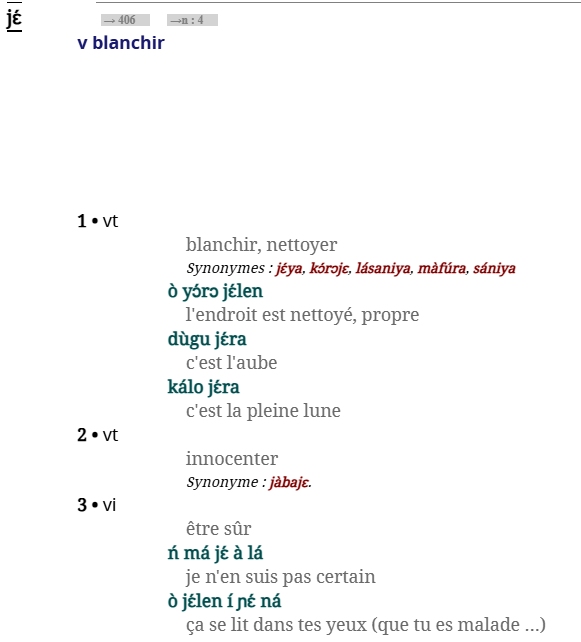
I used the word jɛ because when I am in Mali, people are amazed that I learned bambara and they say i ka bamanakan jɛlen don as it your bambara is clear. But I personally think I have a lot more to improve on and learn!
So I said fo ka jɛ “until it’s clear”
From
bamadaba dictionary
2 Likes
Aw ni ce!
I think that @malikdiallo explained it very well! I ni ce, karamɔgɔ! 
But just to add a little bit more…
To be clear (no pun intended), ka jɛ literally means “to whiten” and it is often used to say something like “clean”.
The expression fo ka jɛ, literally, translates as “until (to) whiten”.
A ka di n ye k’a kalan fo ka jɛ
Lit. “It is pleasing to me to study it until to whiten”
But yes, it makes more sense to translate it as meaning “until it’s flawless” or “until it’s clear”.
(Dramane translating it contextually as “until the end” makes sense in this regard because basically he means “until one has mastered it and it’s flawless”.)
I should note that it’s arguably not fo ka jɛ, but rather fo k’à jɛ (< fo ka à jɛ “until to it whiten”). (Just like the Bamadaba example that Malik gave above; where it is written “fo k’à bonya”.) But there are expressions with fo ka and no direct object. For instance, fo ka tɛmɛ (Lit. “until to pass”), which is often used to say something like “excessively”:
À ka di n ye fo ka tɛmɛ
"I like it too much
Hope that adds a little bit more info that is helpful, @Bettina ! Also, I love that you made this expression a topic in the Forum
2 Likes
I ni ce Coleman!
I was also unsure whether it was fo k’à jɛ or fo ka jɛ because I normally hear the word jɛ as a intransitive verb.
Because even in this example it seems like although it is written vt they seems to be all vi
1 Like
Nba! Yeah, it’s an edge case for spelling.
But I had a look at the Bambara Reference Corpus and it seems like fo k’à jɛ is more prevalent in writing. There are 8 hits and they look to all actually be confirmed examples of what we are talking about (e.g., “until to whiten it”).
Take this one:
U y’a ko fo k’a jɛ
“They washed it until it was clean [Lit. “until to it whiten”]”
Here’s the others:
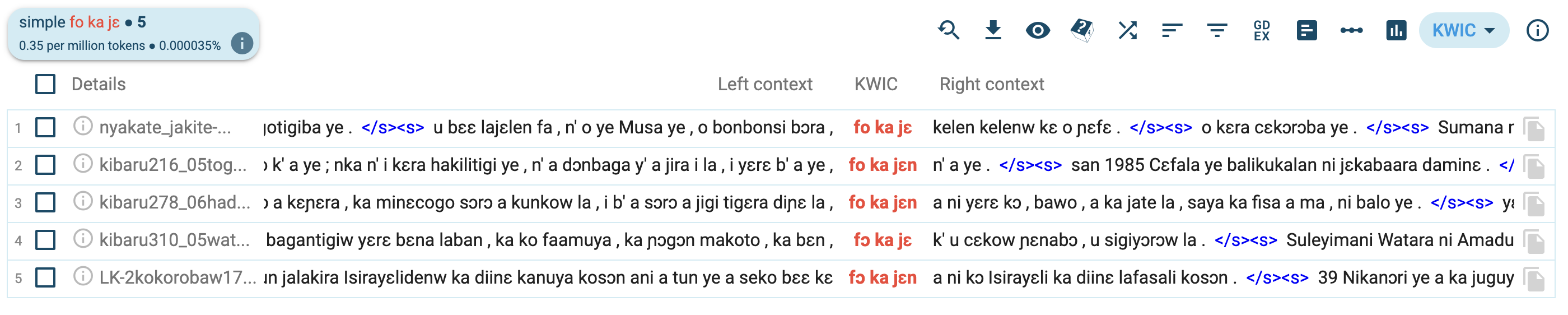
For “fo ka jɛ”, the written form does appear in the Corpus 5 times, but I don’t think that any of the examples of “fo ka jɛ” are actually sentences using the verb for “to whiten”. They all look to be uses of the verb ka jɛn/jɛ meaning ‘to unite’:
So if common written convention is any guide, I’d go with fo k’à jɛ.
2 Likes