I got some feedback from @gregorio via a “Feedback form” so I’m following up with questions here
Is “Dialogs” on purpose? Very clever!
I think that this is good feedback, but what do you mean? The fact that I labeled the collection “Listening Dialogs”?
When filling in an text-box, the auto-grade if the user got the right
answer is nice. Also tab-jumping to the next option and the “enter” to say
complete is nice.
I ni ce!
I probably don’t need the “Start” button.
I see what you mean. I guess I put it in there at first to encourage people to listen once without any specific question or task to do. Maybe I can make that clearer in some other way. Or maybe no one will do it that way so I shouldn’t try to force it I’ll be curious to hear what @Bettina or anyone else thinks…
The level was a lot easier than what I am used to, which means for someone
learning this for the first time, it’s probably a pretty good level.
You have the questions “What time of day is it?” and “How long has it
been?” before filling in the boxes. Maybe after would be more appropriate
like how you had it with other listening exercises. Not a big deal either way
though if you feel otherwise.
Oh! Yeah, I didn’t even think about the “old” listening-style workbook chapters (e.g., this greetings one, etc). This actually makes me think that maybe I should go and recategorize a lot of the old “workbook” chapters that have dialog audio and perhaps put them all in a Listening collection.
All in all I think it’s really good! It’s very important to do these
lessons as a learner and I think they’re set up quite well. 10/10 A+ Baara
ɲuman! (“Good job”?)
I ni ce! People would actually normally say “I ni baara” for this kind of thing. Or you can say “Baara ɲɛna” from the verb ka ɲɛ. That would sound very natural too!
UPDATE: I added a “fancy” version of the Review section using a fancy transcript tool to the same chapter.
It’s not polished yet in terms of styling (i.e., color, etc), but I’m curious if you @gregorio or @Bettina might think that this kind of “Transcript” tool is useful here and/or with similar audio content.
Oh, my mistake, I didn’t know “dialog” was an alternative spelling to “dialogue” and thought it was a portmanteau of “dialogue” and “travel-log”. I’m even learning English here.
I added a “fancy” version of the Review section… curious if you… think that this kind of “Transcript” tool is useful here and/or with similar audio content.
Wow, really impressive code. It’s definitely well done. Baara ɲɛna
As for whether it’s useful here, I’m not sure. Since at this point in the dialogue the learner will have already done the sentence completion section, they may at this point no longer need the extra help to parse the sentences.
However, this may be useful in other learning-contexts. Maybe if you spliced some of your street interviews and added this feature it would help people follow your other dialogue (then again your street interviews have really nice captions already so not a huge incentive there either).
I think I got a B- … it was quite broken. Thinking back on that though, I wish I had a audio to go with it. Just a thought but your moving highlight would be fun over a longer story, and since you have the word search, it may work better for a longer text too.
Haha, my mistake! I didn’t even know that “dialogue” was an option anymore
Yeah, you are right in general for most learners
But my thinking was that for me and/or student review or reference purposes, it still might be useful to have it at the end with no need to go through the questions to see the transcript/translation.
I think that actually in an ideal world, all of the substantive audio/listening dialogs would be something that you could listen to in a special “listening” mode where you could basically cue them up like a podcast (and optionally turn on your screen and look at the transcript/translation if you wanted) and even put them into a single list and let it run through all of them.
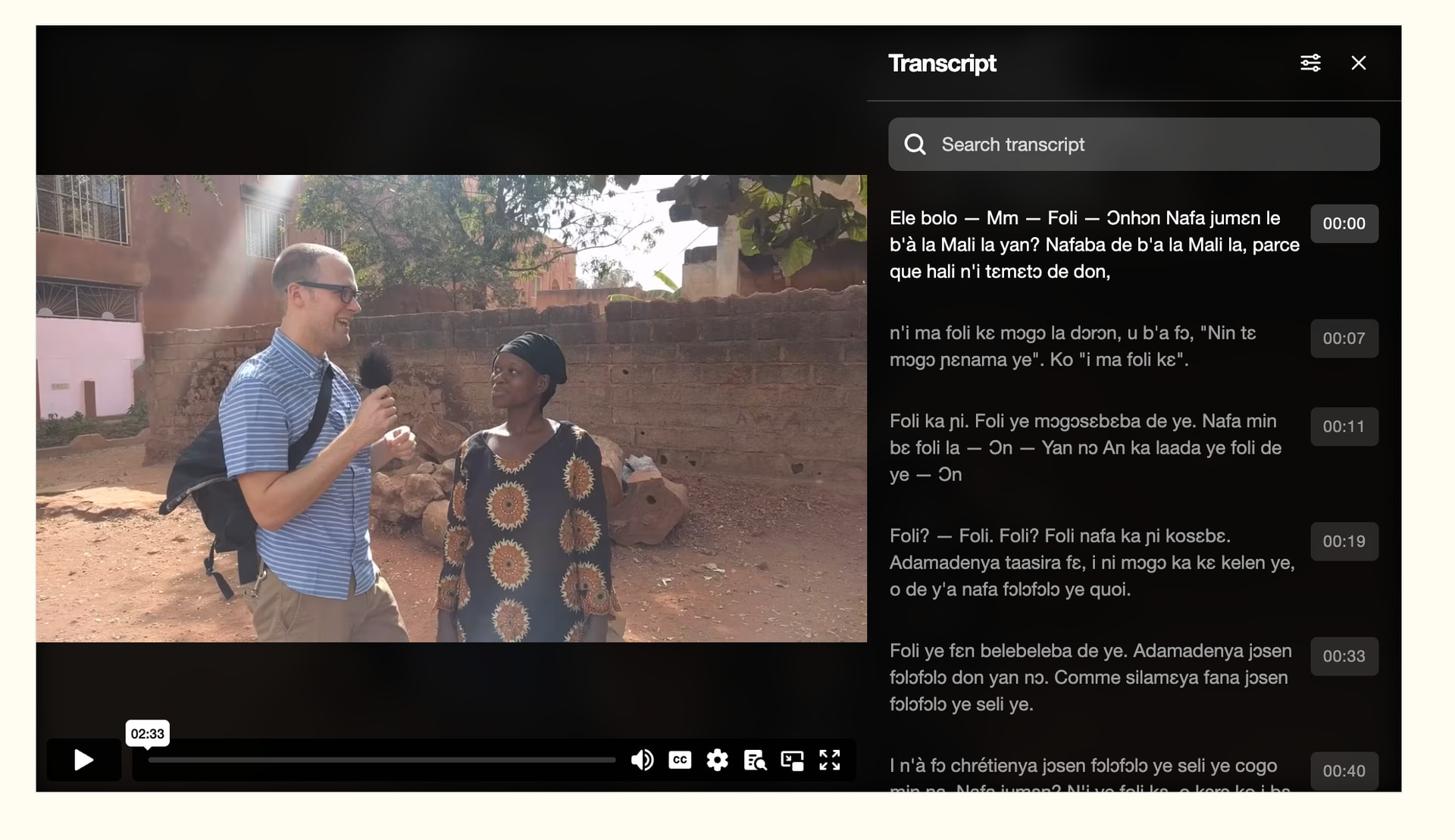
This is actually exactly what I have been building out and testing in the Intermediate coursebook that I am making/teaching this semester. The clips of the street interviews use a player with subtitles that can be switched between languages and turned on/off (and browsed and searched as a transcript as well)
I have been experimenting with adding an “audio” only option below the video as well in the Reader collection for my Advanced seminar course too. One student said they really liked having that option since they often listen to audio a few times after watching the video once for homework. And sometimes, they stop it and look at the long transcript with the highlighting.
And yeah, I totally agree it working well with other longer stories/texts/recordings. Here’s a random test one that I made with a griot recording that I previously taught in another more advanced course.
Really cool that you built something around the Petit Prince translation as well! I wish that I could code similar stuff on my own too!
That’s fair. And there’s no harm in having it anyway.
This is actually exactly what I have been building out and testing in the Intermediate coursebook that I am making/teaching this semester.
O ye kabako ye! You were way ahead of us on that then. This looks really amazing.
Sògo yé nɛ̀gɛ dòni tùma mín ná, à yé í dɛ̀mɛdɛmɛ kómi í ná à fɔ́ fúru júgu. / Once the animal bore the lead, it puttered along like a bad marriage.
First of all: the new category “listening dialog” is great. I love it!
It took me 3min. from my phone.
I went through both sections.
The dialog length is about right for beginners.
The number of “Practice” questions could be a bit more. Ideal could be 5 questions. Their level feels about right.
Confusing was at first the Review section. I was confused, why after I had already done the exercise, there was the whole text again. But now I think it’s great. In case someone hasn’t understood everything quite well in the listening dialog, they can review it.
The new fancy “Transcript” tool is great and feels especially useful to read along in the Review section. When I first did the Beginner course, I remember all the audios sounded so quickly spoken to me. So I think this will be very helpful in the Beginner course and of course in all the other courses/levels, too.
 Here is the new prototype for “Greetings”.
 I’ll be curious to hear what
 version of the Review section using a fancy transcript tool to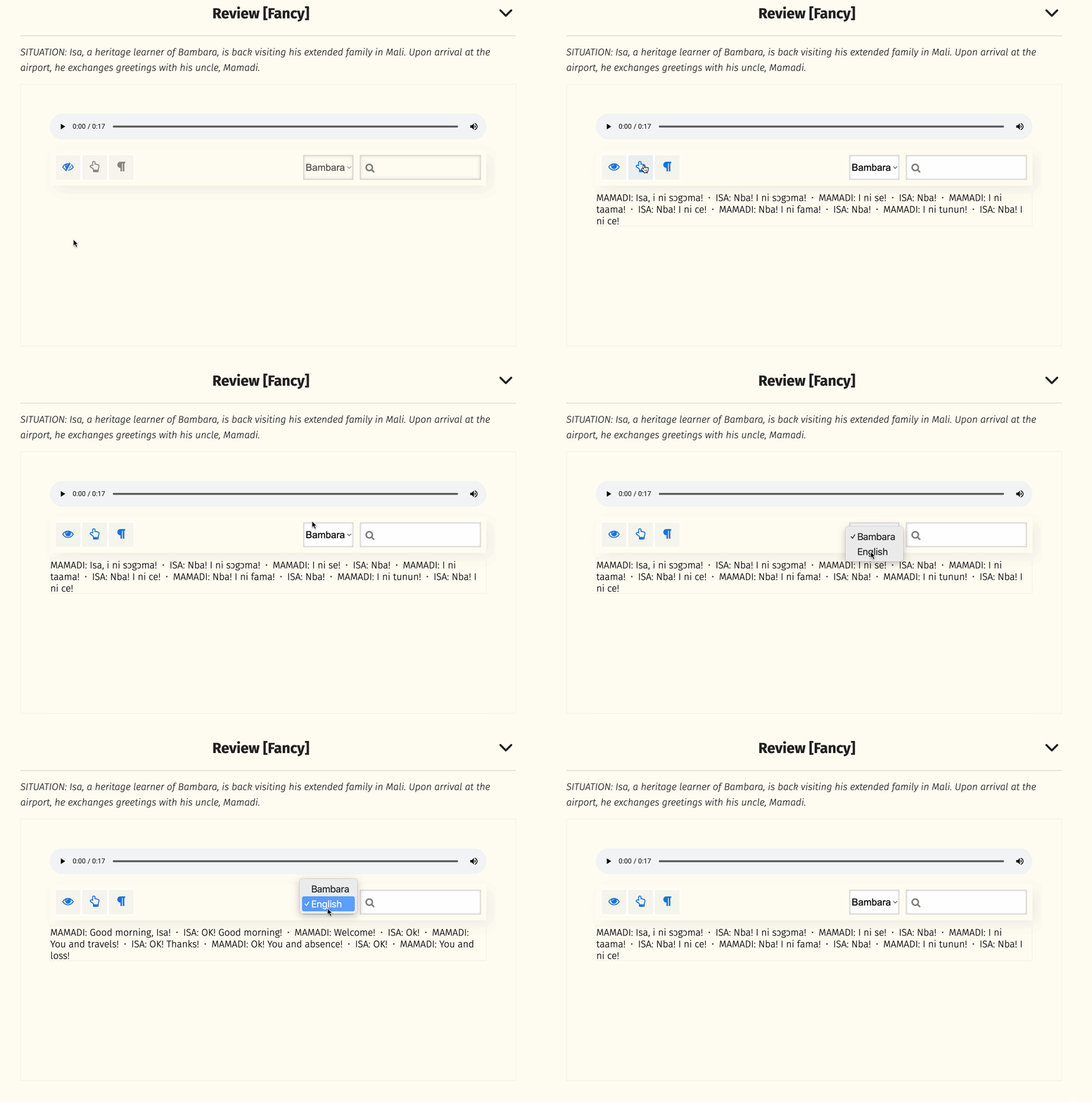


 … it was quite broken. Thinking back on that though, I wish I had a audio to go with it. Just a thought but your moving highlight would be fun over a longer story, and since you have the word search, it may work better for a longer text too.